When there are hundreds of different types and varieties of polymers, why use an additional process called Compounding?
The answer is very simple. Most of us begin our day by using a compounded product. The making of bread dough is a classic
case of everyday use of compounded wheat flour. Actually, this operation can very well be done using a Twin-screw
Extruder, because, the fundamental process of compounding is the same.
Compounding is used to make "new" plastics in modern times, because - a vast variety of plastic-material(s) is
required to 'satisfy' a wide-range of 'applications' and also 'endusers'. Also, to discover and manufacture a new
molecule to fit each one of these applications is a phenomenally expensive proposition. Compounding offers a quick,
easy, low-cost alternative to discover new molecules. That is the reason why compounding has become such a popular
process to modify properties of the base polymer. Actually, some of the very interesting polymers would have never
become commercial success, if they were not compounded. PVC, for one, is a well-known example. Noryl® (PPO® blends from
GE Plastics) is another. In fact, until a few years ago, most polymers were compounded immediately upon synthesis because
they would not survive without additives and stabilizers for more than several hours unless elaborate measures were
taken to protect them from air (oxygen), light and heat. Polypropylene is an example. There are new processes and
technology, which incorporate these additives in the final stages of the reaction, thereby eliminating the compounding
process, which was so critical for the polymer's survival.
Process of Compounding - The 3 M's
The process of compounding actually consists of several different unit operations happening inside the extruder.
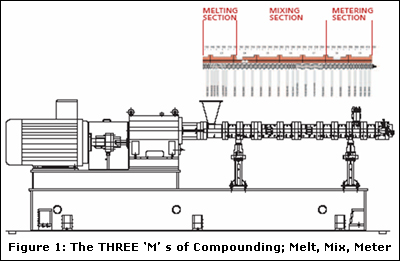
We would discuss each one of these in detail, but the basic process can be defined with the Three M s' – Melt, Mix, Meter.
The difference between normal extrusion and compounding extrusion is that in the latter, there is special emphasis on Mixing
whereas in the former, emphasis is on Melting and Metering. (See figure 1). In "normal" extrusion, either the mixing section is absent or if present, it is quite insignificant. This also suggests that compounding extruders, by virtue of the extra mixing section, tend to have a higher L/D as compared to normal extruders.
The 5-Step Process
In practice, there is much more to compounding than just the three 'M' processes. Actually, it is at least a five-step
process, namely, Feeding, Melting, Mixing, Venting and Metering. More often than not, it becomes a six-step process too,
when there is an additional feeding operation - downstream of the melt section, especially when using glass fibers. The
importance of “process” occurring in Feeding or Venting is a subject for debate – one just feeds the stuff at the
feeding port or applies vacuum at the vent port. In reality, things are not so simple – indeed, the entire process
of compounding seems to be deceptively simple.
Modern Twin-screw Extruders are STARVE-FED devices. Which means that you may NEVER fill-up the feed hopper and control
the output just by setting the Screw RPM. When run with full hoppers, a modern co-rotating, parallel, fully intermeshing
twin-screw extruder will surely be overloaded (few exceptions, though). In practice, these extruders run with their flights
100% full only in specified areas of the extruder. Theoretically, "higher the percentage of filling of flights, better it is
for the material that is being compounded".
This article is contributed by Dr. Babu Padmanabhan, Managing Director and Founder of Steer Engineering. He is a PHD in Mechanical Engineering from Virginia Polytechnic Institute and State University Blacksburg VA.